


The generator business is a fifteen-to-twenty-year service relationship disguised as a one-time install — and the maintenance contract is how that relationship gets structured, billed, and kept. Operators who run a real contract program hold renewal rates above ninety percent and build the recurring revenue base that makes a generator company worth owning. Operators who don't end up re-selling the same customers every fall.
This guide covers what a generator maintenance contract should include, how often standby units actually need service, how to price residential and commercial plans, what NFPA 110 means for your commercial accounts, and how to sell and renew agreements by process instead of memory.
What Should a Generator Maintenance Contract Include?
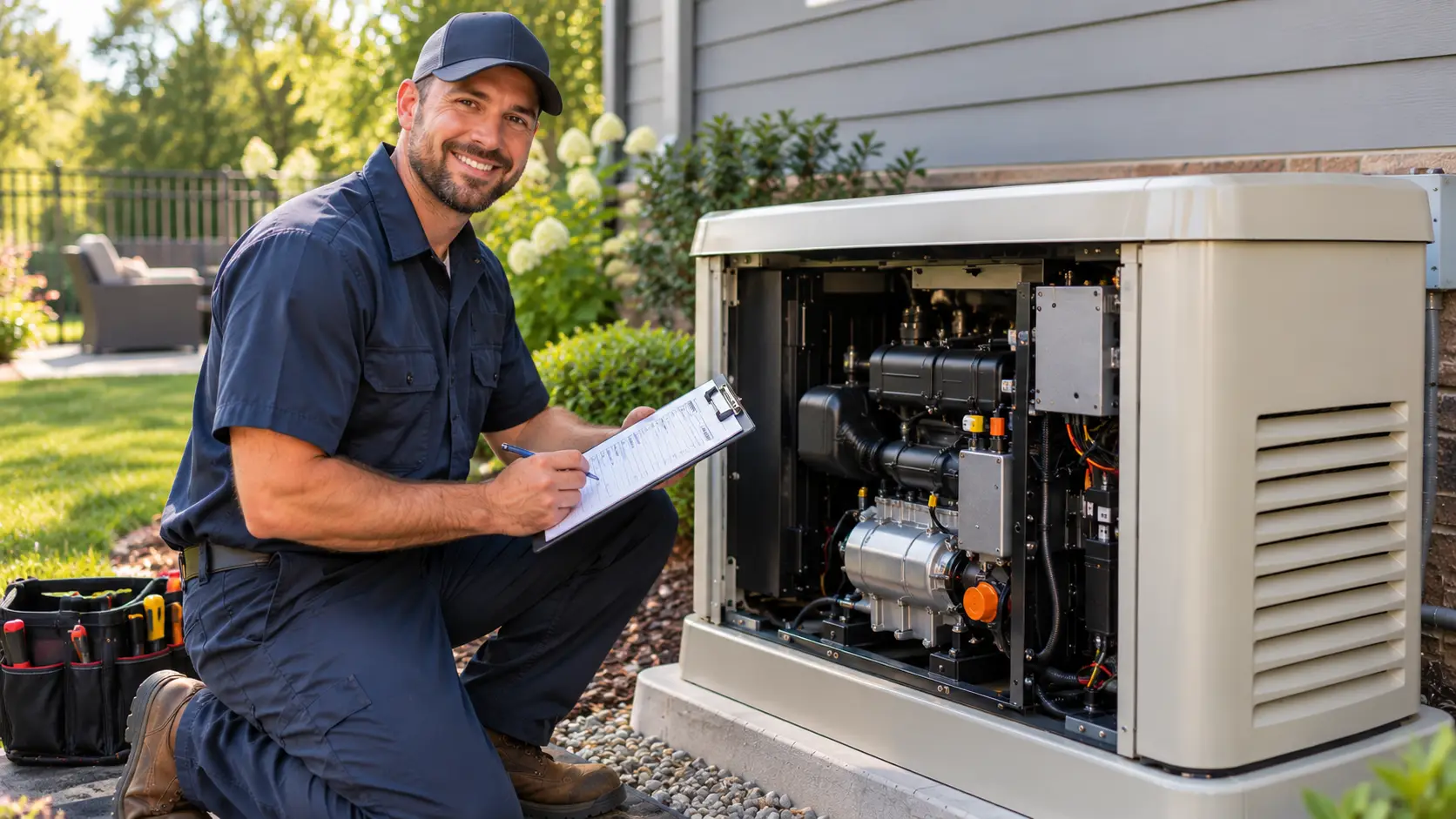
A generator maintenance contract should spell out the visit schedule, the service scope per visit, what's covered versus billable, response priority, and the renewal terms. The core annual scope for a residential standby unit covers the engine and the transfer path: oil and filter change, air filter, spark plugs, battery test and terminals, coolant check on liquid-cooled units, control panel and firmware check, a run test under load, and a transfer-switch exercise to prove the system actually picks up the house when the grid drops. Generac's own maintenance schedules follow this same rhythm — and since roughly seven of every ten residential standby units are theirs, most contracts in the field are built around it.
Just as important is what the contract says about everything else: parts pricing for what the inspection finds, labor rates for repairs outside scope, whether the customer gets priority dispatch during outage events, and what happens at renewal. The contract that answers those questions up front is the contract that doesn't turn into an argument in year three.
How Often Should a Standby Generator Be Serviced?
Once a year at minimum, twice a year for units that matter — and by run-hours for units that work for a living. Annual service fits a lightly-exercised residential standby; semi-annual plans (a full service plus a mid-year inspection) fit customers who treat backup power as non-negotiable, and they roughly double the contract value. Diesel and commercial units add run-hour triggers, fuel quality checks, and more frequent inspection cycles, because a unit that failed to start is a unit that failed at the only moment it existed for.
How Much Should You Charge for Generator Maintenance?
Price the plan on four factors: visit count, unit type and size, what's bundled, and response priority. Most residential standby plans land in the low-to-mid hundreds per year for annual service, with semi-annual plans priced accordingly higher; commercial and diesel work is priced per unit size and visit scope, with load bank testing and fuel services as their own line items. The margin discipline that matters isn't the sticker — it's repricing. Contracts that haven't been repriced in years quietly become the least profitable work on the schedule, so build an annual review into the renewal cycle.
The other pricing lever is what the contract feeds: in a healthy generator service business, a third to half of maintenance customers generate additional repair or warranty revenue every year, because the inspection is what finds the failing battery and the leaking fuel line. The contract visit isn't just billable work — it's the discovery mechanism for everything else.
What Do Commercial and NFPA 110 Accounts Require?
Commercial emergency-power accounts run on documentation, and NFPA 110 sets the rhythm: weekly inspections, a monthly test run of at least 30 minutes under a meaningful load, annual load bank testing when the monthly tests can't reach that load, and a longer multi-hour test on a multi-year cycle for the most critical systems — all with written records of dates, load conditions, durations, deficiencies, and corrective actions. Manufacturer guidance from Kohler and Cummins walks through the same framework.
The facility owns the compliance obligation — but the service contractor produces the records. That's the pitch for the commercial contract: the hospital, care facility, or municipal account doesn't just need the work done, it needs to be able to produce the test history when the inspector or insurer asks. The contractor whose techs capture readings, deficiencies, and corrective actions on every visit — and can retrieve them by unit and date — is the contractor that keeps those accounts for decades. A guide like this NFPA 110 maintenance breakdown is a useful reference for what those records need to show.
How Should You Tier Generator Maintenance Plans?
Three tiers cover most books of business:
● Annual — one full service visit per year, standard scheduling, parts and repairs billed as found. The entry plan that gets every install customer under contract.
● Semi-Annual — full service plus a mid-year inspection and run test, priority scheduling during outage events. The plan for customers who bought the generator because they mean it.
● Commercial / Critical Power — scope built to the account's test cycle and documentation requirements, load bank testing and fuel services as scheduled line items, priority emergency response, and per-unit record delivery.
Tiers do two jobs: they give the install customer an easy yes at startup, and they give the serious customer a reason to pay for the relationship they actually want.
How Do You Sell and Renew Generator Maintenance Contracts?
Sell the contract at startup — the day the unit is commissioned is the day the customer cares most about it starting next time. Every install should leave with a plan attached; every unit in your install base without one is a campaign waiting to be sent. Techs matter here too: the EGSA-certified technician who walks the homeowner through what the annual visit covers closes more plans than any mailer.
Renewal is where contract programs live or die, and it's a process problem, not a sales problem. Renewal reminders that go out ahead of every expiration — automatically, not when someone remembers — are the difference between the ninety-percent renewal book and the leaky one. The same discipline applies to the visits themselves: contracted maintenance that generates its own work orders on schedule never depends on a spreadsheet check.
Running the Contract Program Without the Spreadsheet
A generator maintenance program is a scheduling-and-records machine: visits that generate at each contract's cycle, per-unit histories with every reading and repair attached, renewal reminders that fire before the lapse, and billing that follows each agreement's terms into QuickBooks. That's exactly what generator service software is for — and Smart Service's service agreement tools run the whole cycle from the first startup to the fifteenth renewal. If your contract book is currently a spreadsheet and a good memory, see a demo before the fall rush hits.


