


Painting has the friendliest cost of entry in the trades: a professional can do honest work with a few hundred dollars of brushes, rollers, and drop cloths. That is also the trap. The gap between "a guy with a brush" and a painting business that wins repaints, cabinet jobs, and commercial accounts is a specific set of equipment bought in a specific order, and buying it in the wrong order is how new operators end up with a $3,000 sprayer they use twice a year while losing cabinet jobs for want of a $600 HVLP rig.
This guide breaks down what the equipment actually costs in 2026, what working painters say to buy first, and how the numbers stack up at three startup budgets. Prices are list or typical street prices at the time of writing and will vary by dealer and promotion.
1. The Airless Sprayer: The Production Multiplier
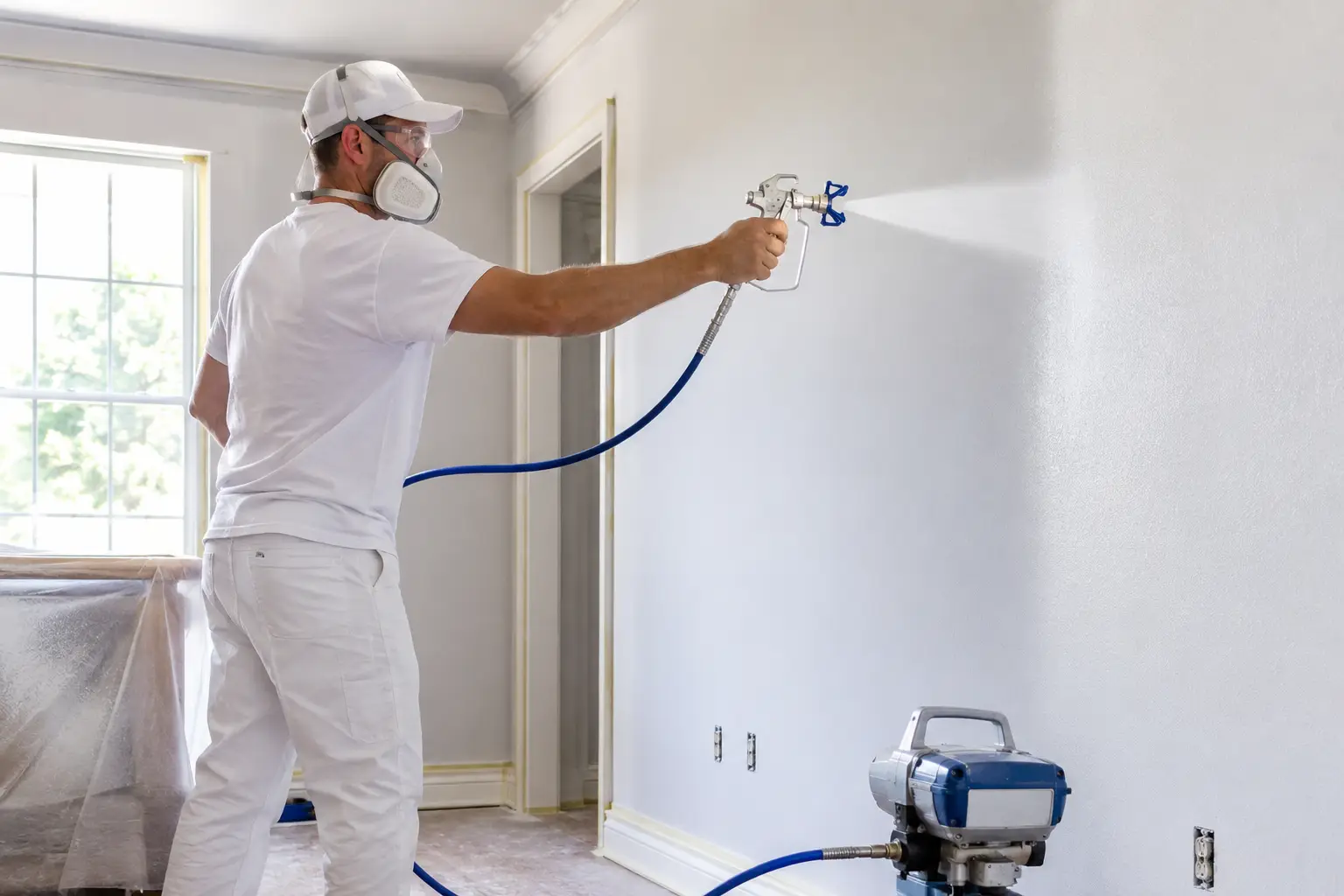
Nothing changes a painting company's economics like the first real airless rig. Walls that take a day to roll take hours to spray, and exterior repaints, ceilings, and new-construction interiors stop being endurance events. The professional standard is a name-brand electric airless: Graco's Ultra Max II 495 PC Pro runs about $1,995 at street price, and the Titan Impact X 440 holds down the other side of the eternal Graco-versus-Titan argument in the $1,300 to $1,700 range. Entry pro units start around $1,100.
The operator consensus is blunt: skip the big-box homeowner sprayers. They exist for a weekend, not a schedule. A pro unit sprays unthinned paint all day, rebuilds instead of retiring, and holds resale value when you upgrade.
2. Brushes and Rollers: The $30 Tools That Define the Reputation
Spraying gets the paint on the wall; brushwork is what customers photograph. Pros standardize on Purdy and Wooster — a quality angled sash brush runs $15 to $30 and, cleaned properly, cuts straight lines for months. Budget a full kit: brushes in two or three sizes, roller frames, quality covers in multiple naps, extension poles, and trays. The whole professional hand-tool setup lands under $500, and it is the highest-return money on this list.
3. Prep and Masking: Where the Job Is Actually Won
Every experienced painter says the same thing: the finish is decided before the first coat. That means canvas drop cloths, a 3M Hand-Masker (about $40, and it pays for itself the first week), caulk guns, patching compound, and sanding blocks. For interior repaints and cabinet work, ZipWall dust-barrier poles ($200 to $400 for a starter kit) turn an occupied kitchen into a contained workspace — the professionalism customers mention in reviews. Exterior work adds a pressure washer for prep; a contractor-grade gas unit runs $400 to $800.
4. Ladders and Access: Buy the Ladder, Rent the Lift
A multi-position ladder system — Little Giant is the name pros default to — runs $300 to $700 and replaces a truck full of single-purpose ladders for interior stairwells and single-story exteriors. Add a quality extension ladder for two-story work. For anything taller or commercial, the math favors renting a boom or scissor lift by the job and pricing it into the estimate — owning one is fleet-company territory.
5. The Cabinet Money: HVLP and Dust Extraction
Kitchen cabinet refinishing is the trade's winter revenue — $3,000 to $8,000 per kitchen, indoors, booked in the months exteriors can't run. It demands finish quality an airless can't deliver on doors and face frames, which is where HVLP comes in: Fuji's turbine systems run from about $600 for the Semi-PRO tier to $1,100+ for the Q-series units serious cabinet shops use. Pair it with dust extraction for the sanding — a Festool sander-and-extractor setup runs north of $1,500 and is the difference between a cabinet job and a dust complaint. This category is optional at launch and mandatory the first November your calendar goes quiet.
6. Lead-Safe Certification: The $300 That Makes Pre-1978 Work Legal
Any paid work disturbing paint in pre-1978 housing requires an EPA Lead-Safe Certified Firm — the firm certification is $300 for five years, the renovator course a few hundred more, and the working kit (poly sheeting, HEPA vacuum, cleaning verification supplies, test kits) is modest. Given how much of the American housing stock is pre-1978, uncertified operators are simply locked out of a large slice of the repaint market — and the fines for winging it start in five figures.
7. Three Startup Budgets That Actually Work
Brush-and-roll start, $1,500 to $3,000. Full Purdy/Wooster hand kit, drop cloths, Hand-Masker, patching and caulk supplies, a multi-position ladder, and RRP certification. This does profitable interior repaints from day one — plenty of respected companies ran their first year exactly this way.
Production outfit, $5,000 to $9,000. Add the pro airless (Graco 495 or Titan 440 class), an extension ladder, the pressure washer, and ZipWall containment. This tier competes for exteriors, whole-house interiors, and light commercial — the jobs where spraying speed is the margin.
Full-service shop, $12,000 to $20,000. Add the HVLP rig, dust extraction, a second sprayer as backup, and van shelving. This is the tier that sells cabinet packages all winter and never turns down a job for want of equipment.
The Sprayer Does Not Send the Estimate
Everything above buys production capacity. None of it prices the estimate consistently, tells the crew which walls and which sheens were sold, reshuffles the week when rain pushes an exterior, or calls the customer back in year six when the siding is due again — and in painting, the estimate is where the job is won or lost.
That is software's job. Smart Service is painting contractor software built around exactly that: line-item estimates with upgrades priced in, multi-day crew scheduling that survives weather, per-property paint records for the touch-up call, and invoicing that closes straight into QuickBooks. If you are pricing out equipment, you are close to launch. Get a free demo and see the business side before the first drop cloth goes down.


