


It was your best month all year. Then Friday came and you couldn't make payroll.
You did the work. You sent the bills. The money just hadn't come in yet.
That gap, between what you billed and what actually hit the bank, is where good service companies get into trouble. Not because they're doing bad work, but because they're watching the wrong number.
In the video below, Skip Stringfield, founder of Smart Service, walks through Company Pulse in about a minute.

Revenue Is What You Billed. Cash Is What You Collected.
Revenue is the total of the invoices you sent. Cash collected is the money that actually landed in your account. On a good day they're close. In a service business, they're almost never the same.
A commercial account pays on 30-day terms. A homeowner finances a system replacement and the lender pays a week or two later. A property manager batches invoices and pays once a month. A few customers just pay late. Every one of those jobs counts as revenue the day you invoice it. None of them is cash until the check clears.
That's why "how's business?" gets answered with "busy," and busy isn't an answer. Busy is trucks moving. It doesn't tell you what you billed, what you kept, or whether the money ever showed up.
The Summer That Looked Great on Paper
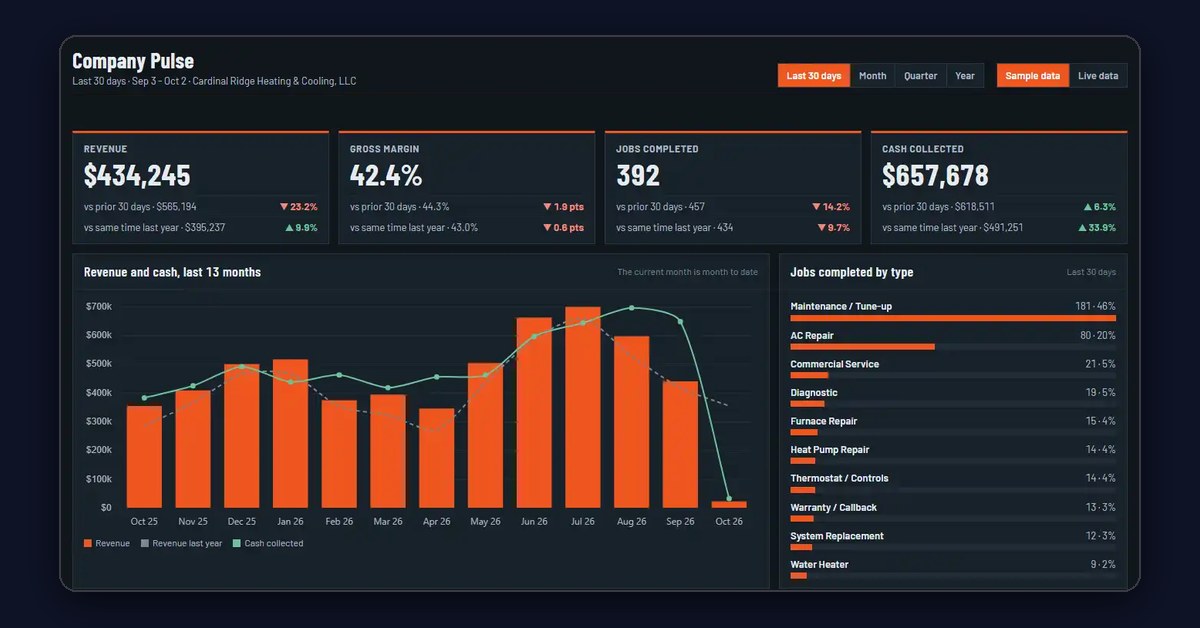
Here's what it looks like on a real board. The HVAC company on the Company Pulse board billed $662,457 in June and $699,939 in July, its two biggest months of the year. Cash collected in those same months: $597,447 and $643,821. Two months in a row, cash ran under revenue.
Nothing was wrong. The company was busy, the work was good, and the customers were paying. They were just paying later than the work was getting done. In August and September the money caught up: $695,767 collected in August and $648,334 in September, both well over what was billed those months.
The owner who only watched revenue saw a record summer and a slow fall. The owner who watched cash saw the opposite: a tight summer and a strong fall. Both were looking at the same company. Only one of them knew whether payroll was safe.
The rule of thumb: when cash runs under revenue for two months straight, you're not short on work. You're waiting on money. That's a collections problem, and it has a collections fix.
The Four Numbers Worth Checking
You don't need a 40-tab report. You need four numbers, every day, and the right thing to compare them to.
Revenue. What you billed. It tells you how busy you were.
Gross margin. What you kept after the direct cost of the job: labor, parts, and materials. In his video, Skip calls this "the money number." A company can grow revenue and shrink margin at the same time, and that's the version of growth that ends with more work and less money.
Jobs completed. How much work actually got done. When revenue drops but jobs hold steady, the mix changed. In the fall, tune-ups replace big summer repairs, and the average ticket comes down.
Cash collected. What hit the bank. This is the one you make payroll with. You can't make payroll with an invoice.
Compare Against the Right Thing
A number by itself doesn't tell you much. For most HVAC companies, October revenue is lower than July revenue. That's not a problem. That's October.
So every number needs two comparisons: against the last 30 days, to see the short-term trend, and against the same time last year, to see whether you're actually growing. On the same board, revenue for the last 30 days is down 23.2% from the 30 days before, which sounds bad, and up 9.9% from the same time last year, which is the real story. Cash collected is up 6.3% and 33.9% on those same comparisons.
Same company, same month. The first comparison makes you nervous. The second one tells you the truth.
What to Do When Cash Runs Under Revenue
When the gap shows up, the fix is usually not more leads. It's getting paid for the work you already did.
Invoice the day the job closes, not at the end of the week. Take payment on site when you can. Know which invoices are past 30, 60, and 90 days, and have someone call them on a schedule instead of when it gets scary. If commercial accounts are most of the gap, look at their terms before you take on more of that work.
If past-due invoices are the bigger problem, the Collection Management page shows how Smart Service sorts every open invoice by age and tells you who to call first.
How Smart Service Shows It
Company Pulse is one screen in Smart Service that answers the question every owner asks: did we make money this month?
Across the top: revenue, gross margin, jobs completed, and cash collected, each compared to the prior 30 days and the same time last year, with the arrow pointing the right way or the wrong way. Switch between the last 30 days, the month, the quarter, or the year, and every number follows.
Below that, 13 months of revenue as bars, last year's revenue as a dotted line, and cash collected as a line over the top, so you can see the gap open and close. Next to it, jobs completed by type: tune-ups, repairs, diagnostics, replacements, and what share of your work each one is. At the bottom, a month-by-month table with revenue, gross margin, jobs, average invoice, and cash collected, with a one-click CSV export for your accountant. Tap any number to drill into the jobs behind it.
And if you want a tile changed, you ask for it in plain English.
Skip's line at the end of the video is the right one. It's the company's pulse: at a glance, super fast, and you know where you stand before the month is over, not three weeks after it.
Frequently Asked Questions
What's the difference between revenue and cash flow?
Revenue is the value of the work you invoiced. Cash flow is the money that actually moved in and out of your account. A service company can bill $700,000 in a month and collect $640,000, because some customers pay on terms, through financing, or late. Revenue tells you how busy you were. Cash tells you whether you can make payroll.
Can a business be profitable and still run out of cash?
Yes, and service businesses do it all the time. If your margins are healthy but customers pay 30, 45, or 60 days after the work is done, you're paying your techs and suppliers now for money you'll collect later. During a busy stretch, that gap grows. Watching cash collected next to revenue is how you see it coming.
What numbers should a field service owner check every week?
Four: revenue, gross margin, jobs completed, and cash collected, each compared to the last 30 days and the same time last year. Add your booking rate if the phones are your bottleneck. If you can only check one, check cash collected.
See Your Own Company Pulse
If you can't say what you billed last month and how much of it you collected, start there. Smart Service is field service software built for HVAC and every other trade, it integrates with QuickBooks, and it keeps the office and the trucks on the same screen. Book a free demo and we'll show you Company Pulse with your own numbers on it.


